
Chandrayaan 3: How Atal Bihari Vajpayee modified India’s lunar mission title from Somayaan
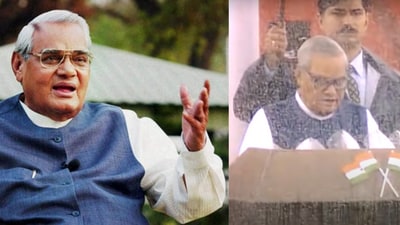
With Chandrayaan-3 gearing up for its touchdown on Moon, there’s an fascinating story of its genesis and the way it received its title. Back in 1999 when the lunar mission was given governmental approval, India’s prime minister was Atal Bihari Vajpayee. He not solely motivated area scientists to discover the moon but in addition used his Sanskrit abilities to rename the mission ‘Chandrayaan’ as a substitute of ‘Somayaan.’
This twist in naming raised eyebrows throughout the area group, as their preliminary alternative, ‘Somayaan,’ had drawn inspiration from a Sanskrit verse: “O Moon! We should be able to know you through our intellect. You enlighten us through the right path.”
“Vajpayee said the mission should be called Chandrayaan, and not Somayaan, as the country has emerged as an economic power, and will make many exploratory journeys to the Moon,” recalled Dr Ok. Kasturirangan, the then chairperson of the Indian Space Research Organisation (ISRO), reported Deccan Chronicle.
Kasturirangan was among the many high invitees to New Delhi in May 1999 to make shows to mark the primary anniversary of Pokhran II. He informed the news web site: “It took four years to plan the mission, and another four years to implement it.”
ALSO READ: Atal Bihari Vajpayee’s 3 iconic contributions to India’s science & know-how
The origin story of the Chandrayaan mission
1. According to ISRO, the idea of an Indian lunar mission emerged in 1999 via discussions throughout the Indian Academy of Sciences, adopted by additional talks throughout the Astronautical Society of India in 2000.
2. Drawing from insights offered by consultants in these boards, the Indian Space Research Organisation (ISRO) established the National Lunar Mission Task Force, comprising distinguished scientists and technologists.
3. This activity drive engaged in deliberations to judge the feasibility and specifics of an Indian mission to the Moon, contemplating its potential goals and configuration.
4. After thorough exchanges, a unanimous advice emerged that India ought to certainly undertake a lunar mission, pushed by heightened worldwide lunar curiosity and the chance for scientific development, together with challenges past the Geostationary Orbit.
5. Subsequently, in November 2003, the Government of India accredited ISRO’s proposal for the inaugural Indian Moon Mission, paving the best way for Chandrayaan-1 to take flight.
Addressing the nation from the rampart of the Red Fort on India’s 56th Independence Day in 2003, Vajpayee unveiled the primary moon exploration plan of India- Chandrayaan 1. He trumpeted, “Our country is now ready to fly high in the field of science. I am pleased to announce that India will send her spacecraft to the moon by 2008. It is being named Chandrayaan.”
Source web site: www.hindustantimes.com


